commute notes

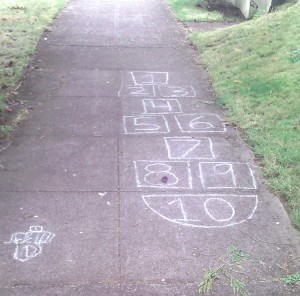
hopscotch numbered from the top with tiny hopscotch beside it

I am pretty sure I’ve never seen a hopscotch grid numbered from the top. I kept trying to make sense of it after I had walked past, and ended up walking around the block to look again.

I have, however, seen a tiny hopscotch marked “for cats,” and I wonder if that’s what the smaller one is here. I can’t quite read the numbers.

———————————————————-
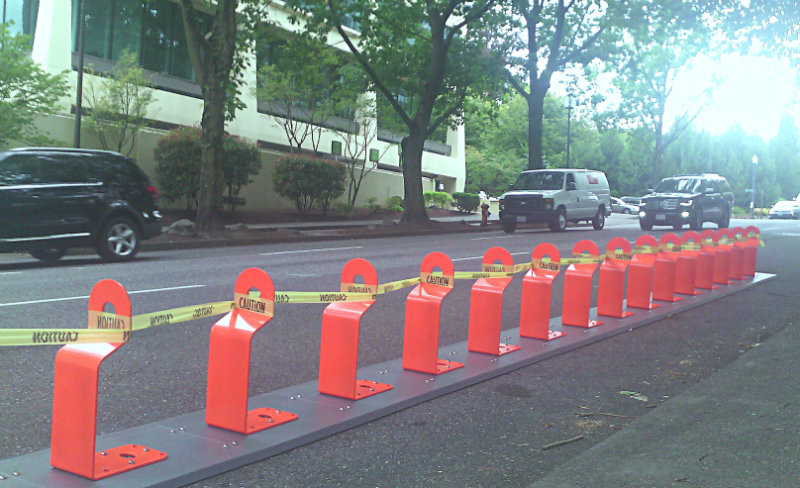
orange racks ready for Biketown bikes

Portland’s Biketown (because co-sponsored by Nike) bikes arrive tomorrow! The racks have been in place for a week or so– people happily started locking their regular bikes up at them, and then the city sent out some grumpy tweets and added the CAUTION tape.

This rack is just outside my office, so I’ll try a ride down by the river on my lunch break sometime soon. I admit, I don’t really understand the customer base for bikeshare. Commuters would want their own bikes, right? Some tourists will use them, in good weather, if they’re not afraid of sharing the road with cars downtown. Maybe close-in bar hopping after the bus stops running? I guess we’ll find out.
Throwback Thursday: Runway Walk

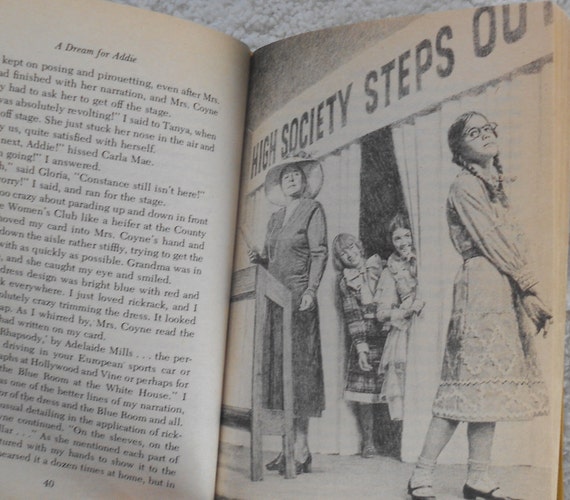
illustration of style show from A Dream For Addie

I surprised sanguinity this morning with a skill from my past– a practiced runway walk, complete with stop, pivot, and graceful gestures at features of my clothing as they are described by the narrator (who was also me).

I learned it in 4-H, because we had a fashion show every year to show off the clothes we sewed, knitted, and crocheted.

Granted, mine is the smiley midwestern version, more A Dream For Addie than Project Runway. But then, I was modeling a Rick-Rack Rhapsody navy-blue t-shirt from JCPenney. Frump Power!

Reading Wednesday

Off and on this year I’ve been reading malt-shop YA that I get via interlibrary loan– Anne Emery’s set of four about the Burnaby girls, and last week, to commemorate Lois Duncan, her first novel Debutante Hill. I love the malt-shops, but their worlds are relentlessly white and after awhile I was longing for books from the same period about black girls.

The closest I came up with was Brenda Wilkinson’s Ludell, published in 1975 but set in 1950s Georgia where Wilkinson grew up. Ludell would be categorized now as middle grade, and its sequel, Ludell and Willie, as YA. I’m still waiting for the third one, Ludell’s New York Time. 

The first two have all the back-then vocabulary and detail that I love about old kidlit. This is before school lunch programs, so the teachers sell boiled hot dogs and candy and soda at lunchtime. Blue jeans as girls’ fashion are a brand new thing and the grown-ups disapprove. The jukebox at the after-football dance is called a “piccolo.”

The dialect is stronger than in most books now, and it took me a few pages for my associations with old racist books like the Bobbsey Twins to fade away. I like “nem” for “and them.” And you know how everyone’s always yelling and shouting in Harriet the Spy and The Long Secret? These books are like that too! I mean, I think Ludell is especially loud, like Harriet is. But in both cases, it’s almost everyone, not just the main girl.

Checking dates on Goodreads just now, I see that there are several reviewers of Ludell who say it’s the first book that made them like reading. I heart Ludell. (And Ludell and Willie are a sweet couple.) I will be starting a Wikipedia article about Brenda Wilkinson, in case anyone has favorite articles or links about her.


Rereading The Westing Game

Continuing with my 1970s reread jag, I spent most of my day off this week with The Westing Game. Spoilers ahead.

  • I admire intricate plots and puzzles… and I’m not very good at them. There’s a reason I keep reading Howl’s Moving Castle over and over. This was the first time through Westing Game that I felt like I got almost all of what was going on. That Crow was seeing Angela and Theo as another iteration of her daughter and Theo’s father. That Otis Amber was listed in the phone book as a PI under his own name.
  • Sam Westing is a despicable man. He executes the game to punish Crow, using her as a sacrificial queen in his search for someone smart enough to be his heir– Turtle, as it turns out. He has monitored his ex-wife for years and years via private investigator, and is fine with her wrongful arrest for homicide. Not cool. Never addressed. Sorry, Chris, Mr. Westing was not a good man.
  • Crow’s hair is red-blonde. I always pictured her with black hair, very goth and severe with her white skin. Probably because of her name.
  • The last chapter made me laugh. Doug Hoo has to be an Olympic medalist! Judge Ford has to get to the U.S. Supreme Court! Turtle has to make millions and millions! Somewhat more disturbingly, she marries Theo just like Violet should have married Theo’s father. Such a relief that someone (Chris) gets a partner who wasn’t involved in the game at all.
  • I think the book’s most egregious fault is its treatment of Mrs. Hoo. Raskin reports her thoughts and opinions as though they are as simple as the English she has only recently started to learn. The effect is sooo racist.
  • The $10,000 that each player received would be just over $38,000 in 2016 dollars. Harvard and Radcliffe charged $1,250 per year for undergraduate tuition in 1958, so maybe $10k is realistic for Judge Ford’s education, especially if it’s not adjusted for inflation between her student years and the book’s setting (assuming it’s more or less contemporary with the 1978 publication date).

Lots of cool stuff about the manuscript, process, and design of the book here. I first read a hardback library book, but now I have an Avon-Camelot paperback and so miss out on some of the design details.